
![[회전]Research_banner.png](https://static.wixstatic.com/media/977c5b_0f28290b44354228a06b67b4f31cea20~mv2.png/v1/fill/w_980,h_134,al_c,q_85,usm_0.66_1.00_0.01,enc_avif,quality_auto/977c5b_0f28290b44354228a06b67b4f31cea20~mv2.png)
Research
Research Area
Batteries
Batteries are central to modern energy technologies, from electric vehicles to large-scale energy storage. Lithium-ion batteries offer high energy density and reliability, lithium metal batteries promise the ultimate capacity, and sodium-ion batteries provide a sustainable, cost-effective alternative.
Our laboratory studies the fundamental reaction mechanisms and degradation processes in these systems, aiming to uncover the origins of performance limitations and guide the development of safer, more durable, and higher-performance batteries.


01. Lithium-ion batteries
Lithium-ion batteries are at the heart of electric vehicles and energy storage systems, and their further advancement critically depends on the development of high-performance cathode materials.
Our laboratory focuses on understanding the fundamental reaction mechanisms and degradation behaviors of advanced cathode materials, including high-nickel NMC, Li/Mn-rich (LMR), and LiNiO₂ (LNO), which are among the most promising candidates for next-generation lithium-ion batteries.
Through atomic- and nanoscale investigations, we aim to uncover the origins of performance limitations and provide fundamental insights that guide the design of more durable and higher-energy cathode materials.

[Investigation of sub-primary particles of NCM cathode materials]
S. –Y. Lee et al., Advanced Science 6, 1800843 (2019) (Link)

[Recovery of Li/Mn-rich cathodes by heat treatment]
B. Qiu, M. Zheng, S. –Y. Lee et al., Cell Rep. Phys. Sci. 1, 100028 (2020) (Link)
02. Lithium metal batteries
Lithium metal batteries represent the ultimate form of rechargeable batteries, offering the potential to dramatically surpass the energy density of conventional lithium-ion batteries by employing lithium metal as the anode. However, the formation of lithium dendrites and the accumulation of dead lithium remain critical challenges, severely degrading performance and raising serious safety concerns.
Our research aims to uncover the fundamental origins of dendrite growth and dead lithium formation in lithium metal batteries. Based on these mechanistic insights, we seek to develop lithium metal battery systems that exhibit both high stability and superior electrochemical performance.

[Cryo-TEM study for elucidating LiNO3 additive effect in lithium metal batteries]
S. –Y. Lee group, J. Energy Chem. 114, 485 (2025) (Link)

[Operando TEM liquid cell design
for lithium metal battery studies]

[Chemical mapping of SEI on Li,
deposited in the operando TEM experiment]
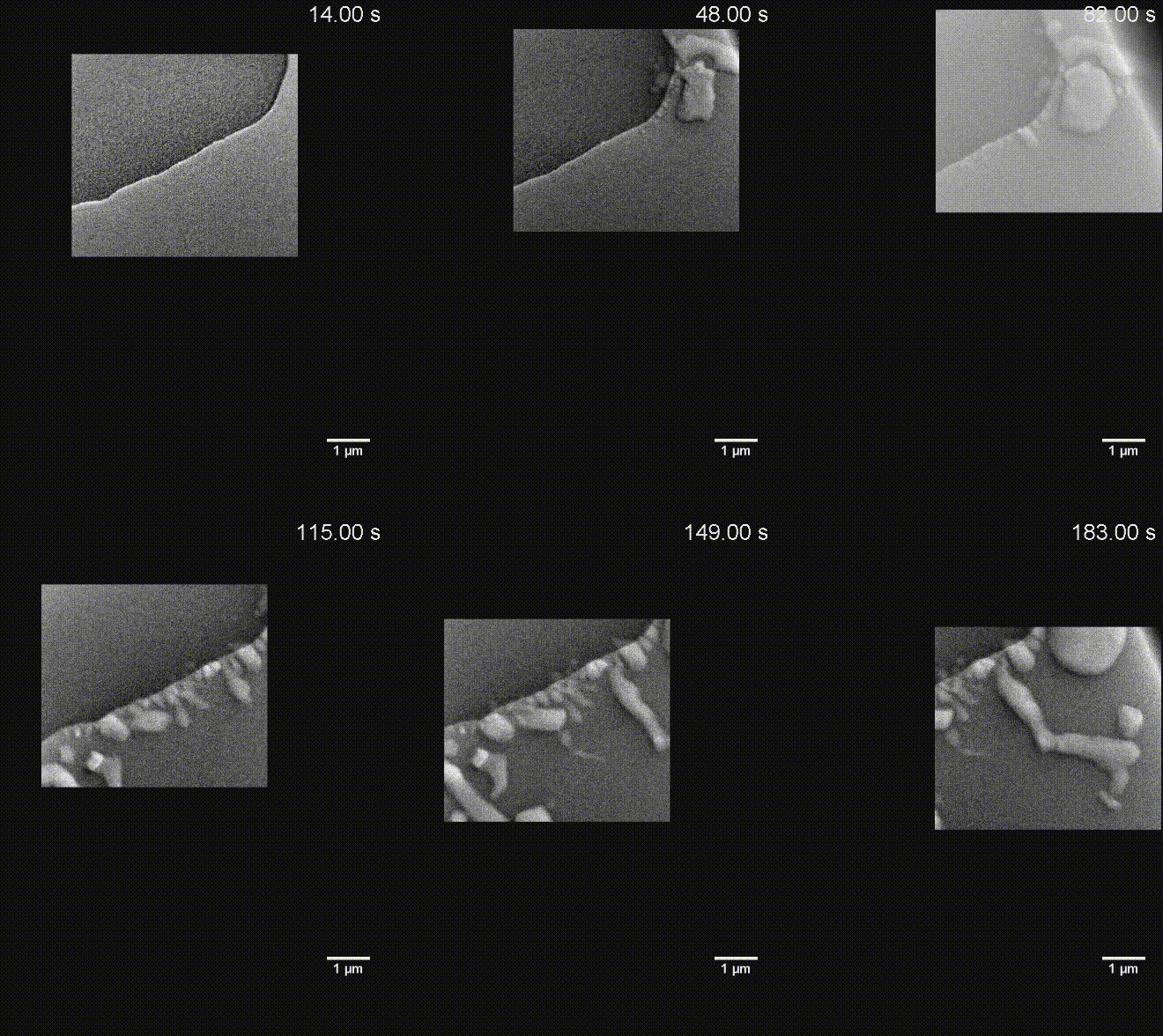
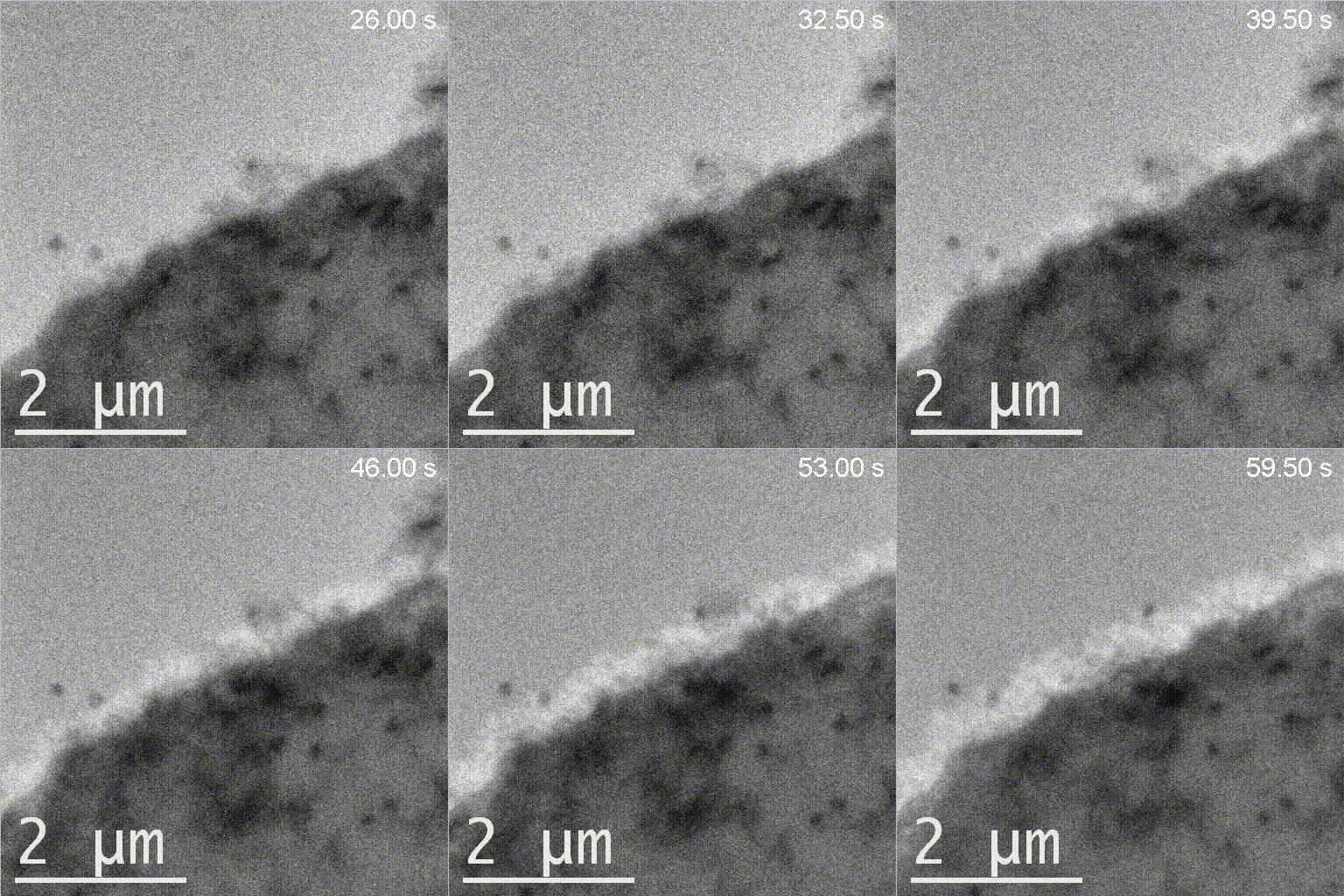
[Operando liquid-phase TEM experiments for lithium metal battery studies:
(left) Li dendritic and (right) Li nanogranular growth behaviors]
S. –Y. Lee et al., Energy & Environ. Sci. 13, 1832 (2020) (Link)
03. Sodium-ion batteries
Sodium-ion batteries (Na-ion batteries) have emerged as one of the most promising next-generation energy storage systems, offering a viable solution to the limited availability and high cost of lithium resources. While their reaction chemistry is largely similar to that of lithium-ion batteries, subtle thermodynamic and kinetic differences between Li and Na ions lead to distinct reaction behaviors and degradation pathways.
Our research investigates the electrochemical reactions and degradation mechanisms of key electrode materials for sodium-ion batteries, including Na(NiFeMn)O₂ (NFM) cathodes and Na metal anodes. By employing a wide range of in-situ and ex-situ characterization techniques, we aim to uncover the fundamental origins of their performance and stability.

[Sodiation mechanism studies of AgMn8O16 Na-ion battery cathodes]
S. –Y. Lee et al., J. Power Sources 435, 226779 (2019) (Link)

[In-situ liquid-phase TEM study of Na metal batteries]
[Ex-situ TEM study of Na(NiFeMn)O2 cathodes]